Hybrid Systems
Lecture · Bachelor / Master
- Summer Term 2024
- Teachers: Erika Ábrahám, Lina Gerlach, József Kovács
Show all terms (12 more)Hide older terms
- Summer Term 2021
- Teachers: Erika Ábrahám, Rebecca Haehn, Jasper Nalbach
- Summer Term 2020
- Teachers: Erika Ábrahám, Stefan Schupp
- Summer Term 2019
- Teachers: Erika Ábrahám, Stefan Schupp
- Summer Term 2018
- Teachers: Erika Ábrahám, Stefan Schupp
- Summer Term 2017
- Teachers: Erika Ábrahám, Stefan Schupp
- Summer Term 2016
- Teachers: Erika Ábrahám, Stefan Schupp
- Summer Term 2015
- Teachers: Erika Ábrahám, Stefan Schupp
- Summer Term 2013
- Teachers: Erika Ábrahám, Xin Chen
- Summer Term 2012
- Teachers: Erika Ábrahám, Xin Chen
- Summer Term 2011
- Teachers: Erika Ábrahám
- Summer Term 2010
- Teachers: Erika Ábrahám
- Summer Term 2009
- Teachers: Erika Ábrahám
Please note
- The number of participants is limited for this course!
What are hybrid systems?
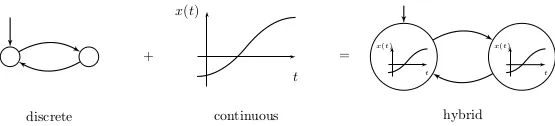
Hybrid systems are systems with mixed discrete and continuous behavior. Typical examples are physical systems which continuously evolve over time and are controlled by some discrete controller, e.g., a chip or a computer.
Why modelling and analysis?
The behavior of hybrid systems is often safety -critical. For example, in case of an accident an airbag can save the life of the car driver, but only if the airbag reacts in time. To assure the correct functioning of such safety-critical hybrid systems, their automatic synthesis and analysis is of high importance.
Lecture content
In this lecture, we learn how to model hybrid systems and how to analyze the behavior of the models using formal methods. More precisely, we will learn methods to solve the reachability problem , i.e. the problem to decide whether any state from a given target set is reachable in a model.
We start with introducing hybrid automata as a modeling language for hybrid systems, define several sub-classes of hybrid automata with increasing expressive power, and for each sub-class we discuss whether the reachability problem is decidable, and develop algorithms for their analysis. Besides exact methods, we consider also over-approximative computations. Finally, we discuss extensions of hybrid automata models and their analysis methods to cover also random (probabilistic) aspects of hybrid systems.
Course organisation
- Number of participants is limited!
- Prerequisites: Basic knowledge in automata theory
- SWS: 3+1
- Language: English
- Exercises: We will provide weekly exercise sheets and solutions. Exercises are not mandatory and cannot be handed in for correction.
- Exam admission: Exam admission is acquired via eTests in Moodle. You will need to get at least 50% of the eTest points to be admitted to the exam.
- Bonus points: You can collect bonus points via Moodle tests, which will be open for a few minutes during the lecture. Bonus points will be added to your exam score and can help passing the exam.
- Contact:
Evaluation from previous years
SS 10: lecturer and lecture (ss10)
SS 11: lecturer (ss11)lecture (ss11)
SS 12: lecturer (ss12)lecture (ss12)
SS 13: lecturer (ss13)lecture (ss13)
SS 14: no lecture (sabbatical)
SS 15: lecturer+lecture (ss15)
SS 16: lecturer+lecture (ss16)
SS 17: lecturer+lecture (ss17)
SS 18: lecturer+lecture (ss18)
SS 19: lecturer+lecture (ss19)
SS 20: lecturer+lecture+exercise (ss20)
SS 21: lecturer+lecture+exercise (ss21)